01 / DEFINITION
The name says exactly what it is
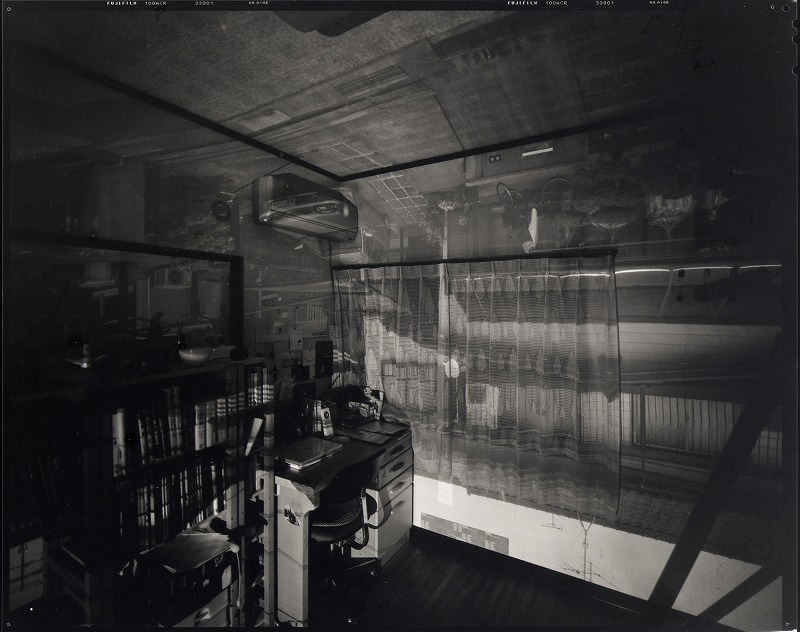
Camera is Latin for room and obscura for dark. It began as a description of a condition, not the name of a device. Our modern word camera still carries a trace of the time when it meant a dark room large enough to walk into.
A version with only a small hole needs three things: a space with the outside light shut out, a small aperture, and a surface to receive the image. Light through the aperture travels straight, so light from the top of the scene reaches the bottom of the wall and light from the bottom reaches the top. The image arrives inverted, left to right as well.
A lens can be used in place of the bare hole. From the middle to the end of the sixteenth century, lenses and mirrors were added at the aperture to obtain a brighter and sharper image, and the plain dark room developed into an optical camera obscura.
02 / COMPARISON
Similarities and differences with a pinhole camera
A camera obscura projects the scene outside onto a surface inside a darkened room or box. It includes both small-hole versions and versions that use a lens.
A pinhole camera forms an image through a small hole instead of a lens. It can be made as a handheld box or as a room-sized apparatus; a light-sensitive surface allows the image to be recorded.
A lensless camera obscura and a pinhole camera share the principle of forming an image with light traveling in straight lines through a small hole. A lens-based camera obscura uses refraction to form the image, so size alone does not distinguish the two.
03 / HISTORY
Known for more than two thousand years before photography
Descriptions of the phenomenon are very old. The optical passages of the later Mohists in the Mozi, from roughly the fourth to third century BCE, are read as describing light crossing at a small aperture so that a person's image is inverted.
In the early eleventh century Ibn al-Haytham described image formation through a small aperture in a dark space, and around 1508–1509 Leonardo da Vinci recorded his observations in his notebooks. In 1544 Gemma Frisius observed an eclipse by projecting it into a darkened room and published the method as an illustration the following year.
Through the seventeenth and eighteenth centuries, the camera obscura shrank from a room into tents, sedan-chair forms, boxes and portable models, and painters and draughtsmen used the projection as a drawing aid. Then, around 1826–1827, Nicéphore Niépce used a camera obscura and a bitumen-coated plate to keep a projected image permanently. That is where photography begins.
04 / WORKS
Turning the space itself into the apparatus
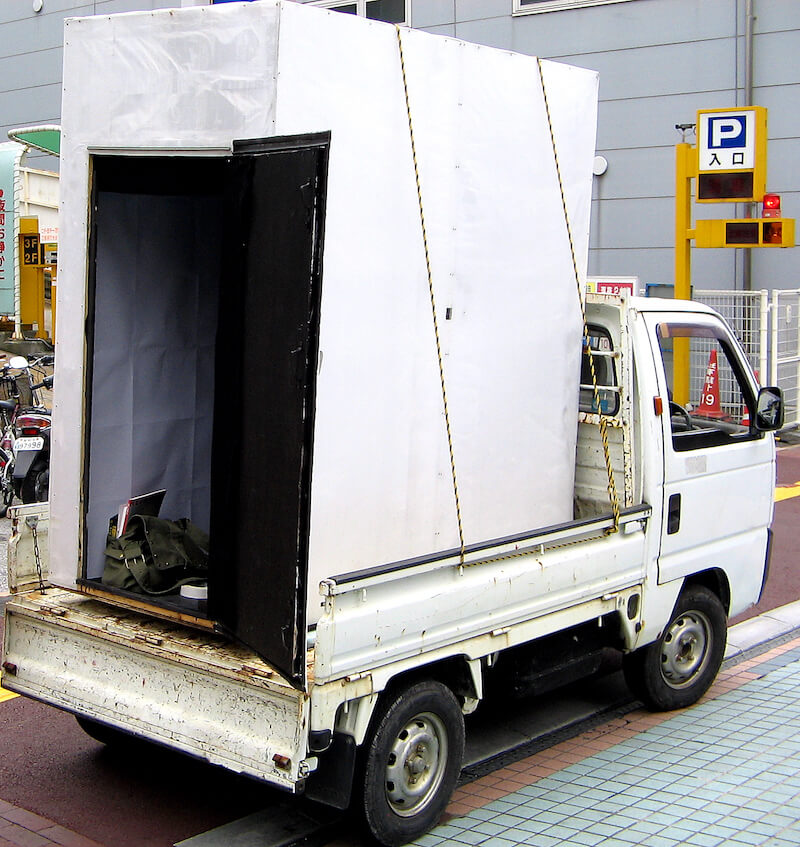
Since 2006 Meisai Okamoto has worked with pinhole cameras and the camera obscura. The bed of a light truck, rooms, a five-metre-square space and existing openings in buildings have all been turned into photographic apparatus.
When a space becomes a camera obscura, the person photographing stands inside the image. The view outside comes down onto the wall and you are in it. That is a different experience from looking at a photograph.